Scroll through enough lot listings in South Gulf Cove and you start to notice the same sentence repeating itself. The community's own HOA describes itself this way on its FAQ page: "It's not your typical HOA with nitpicking rules and fines." The $120-a-year, join-if-you-want structure gets mentioned on lot after lot, almost like a selling point in itself. Cheap dues, a boat ramp, and a clubhouse.
That description of the HOA is true for most of the community. It is not true everywhere in it, and the gap between "most" and "everywhere" is where a buyer's actual costs and timeline get decided. South Gulf Cove was platted with roughly 15,000 lots across about 6,200 acres, according to Charlotte County's South Gulf Cove Community Plan, and only a portion of those lots carry a finished home. That much inventory means a buyer rarely has to settle for one lot. It also means the differences between lots, the ones a listing photo can't show, end up mattering more than the broad community label of "waterfront" or "dry."
The HOA Sentence Doesn't Apply To Every Section
The voluntary HOA covers most of South Gulf Cove, and it really is optional. But the same FAQ page draws a clear line around one part of the community: if a parcel sits in Section 94, it falls under the Waterview Property Owners Association, and the HOA's own page calls that a mandatory HOA that every property owner in the section must join. A buyer who assumes the same $120-a-year, join-if-you-want structure applies to a Section 94 lot is working from the wrong assumption before the closing table.
Here's the practical difference:
| Most of South Gulf Cove | Section 94 / Waterview | |
|---|---|---|
| Governing association | South Gulf Cove HOA | Waterview Property Owners Association |
| Membership | Voluntary, about $120 a year | Mandatory for every owner in the section |
| What stays the same | Deed restrictions apply to every parcel regardless of HOA membership | Same |
That last row matters as much as the first two. The HOA's FAQ is direct about it: the deed restrictions apply to every property in the community, whether the owner is a member or not. Skipping HOA membership does not mean skipping the rules about what you can build, repaint, or fence in.
The Bird That Can Affect Your Timeline
Before a lot ever gets a listing photo, it may already carry a flag most buyers never check: Charlotte County's Florida scrub-jay Habitat Conservation Plan. The county's own plan page states that no vegetation clearing is permitted during scrub-jay nesting season, which runs from March 1st through June 30th. If your closing lands in April and your builder wants to break ground in May, that single sentence can push your timeline into summer.
The fee itself is usually manageable. Compass Land USA, a land-use firm that works Charlotte County parcels, has cited a mitigation fee of roughly $2,200 for a standard 10,000-square-foot lot, though the county reviews and adjusts its fee schedule for inflation every year, so treat that number as a starting point rather than a quote. The same source notes that clearing a flagged lot without the right permits can carry penalties as steep as $100,000 for an individual and $200,000 for a corporation. Those figures rarely appear in a listing description. They show up in the county's GIS map, which is the only reliable way to know before you write an offer whether a specific parcel sits inside the mapped boundary.
The Seawall Nobody Prices Into The Lot
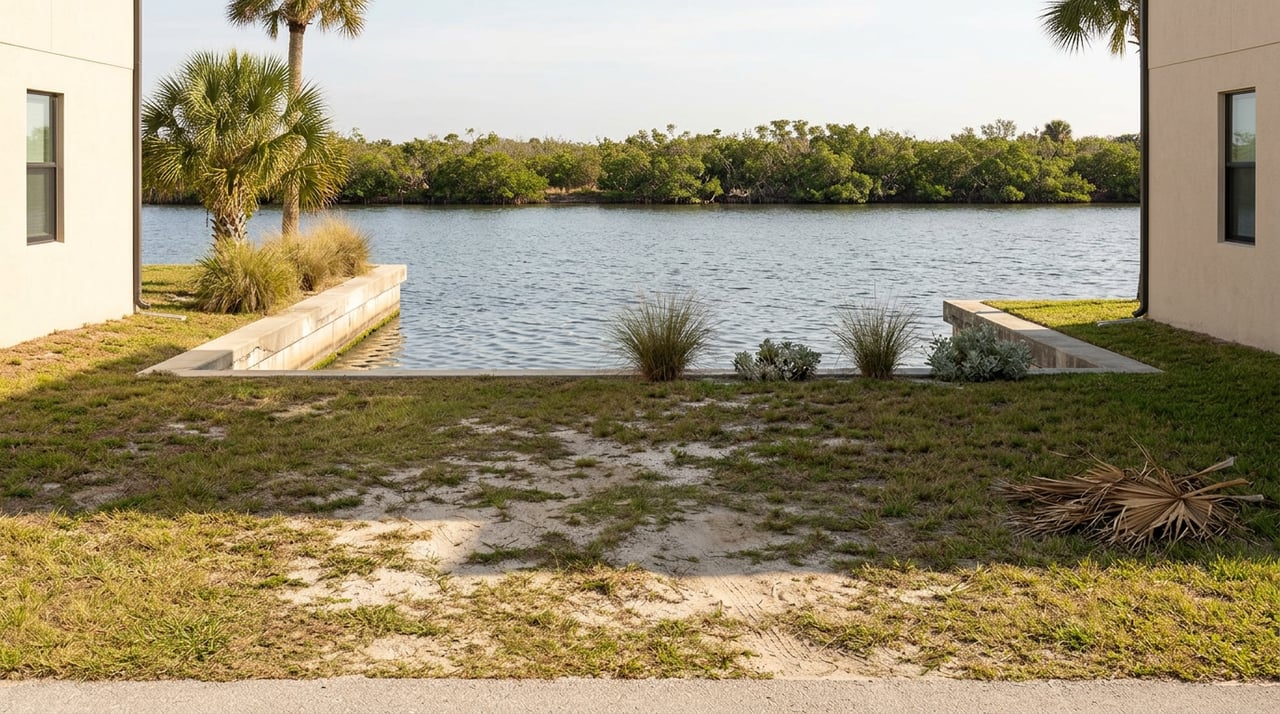
A waterfront lot without a seawall and one with a seawall already installed are not the same purchase, even when the square footage and the water frontage read identically on paper. Building a standard concrete seawall from scratch typically runs somewhere in the $30,000 to $40,000 range. That cost rarely shows up anywhere on the listing itself, which means the sale price of an unwalled lot can look like a bargain right up until you price the wall.
Distance to the lock matters just as much as the wall. Lots closer to the South Gulf Cove Boat Lock and Charlotte Harbor tend to carry a premium over lots several miles deeper into the canal system, even when both carry the same frontage and the same zoning. The label "waterfront" covers a wide range of actual outcomes once you factor in how far a boat has to travel to reach open water, and whether the seawall is a line item you still need to fund.
The Lock Every Canal Lot Depends On
Every home built on a South Gulf Cove canal is, in a practical sense, sharing one piece of infrastructure: the county-operated boat lock that connects the interior canal system to Charlotte Harbor. It is not a background detail. In 2025, the lock was closed for several months before the county and the Florida Department of Environmental Protection worked together to raise canal water levels enough to reopen it, and the county's own maintenance page confirms the lock is operated on a set schedule rather than around the clock.
The county's response has been a proposed parallel lock, designed to give South Gulf Cove a second route in and out of the system and a backup when the existing lock needs repairs. The county's own project page describes the project as still in the permitting, surveying, engineering, and design stage, with no construction completion date listed as of this writing. The canal system itself is funded and maintained through the South Gulf Cove Waterway Benefit Unit, a special assessment district that pays for dredging, lock repairs, and lock operation. If you are buying a lot for the boating access, you are also buying into a shared system with a documented history of downtime and a fix that is still in the planning stage.
Seawalls carry their own layer of complexity beyond cost. A 2020 report from the Sun newspapers described South Gulf Cove property owners losing as much as ten feet of lot depth to canal erosion, on top of a permitting process that involves both the county and the Army Corps of Engineers. That article is several years old now, and it is worth asking your title company or agent whether anything has shifted since.
Four Questions Before You Write An Offer
- What section is the lot in, and which association governs it? Most of South Gulf Cove runs on the voluntary $120-a-year HOA. Section 94 does not. Confirm which one applies to your specific parcel before you assume the dues structure.
- Is the parcel inside the county's scrub-jay boundary? Check the county GIS layer directly rather than relying on a listing's claim either way. If it is flagged, plan your clearing and building permits around the March through June nesting window.
- Does the lot already have a permitted seawall? If not, get a real quote before you compare the purchase price to a walled lot nearby. The $30,000 to $40,000 gap is not small.
- How far is the lot from the lock, and what shape is the lock in? A canal lot five miles from open water behaves differently, both for daily boating and for resale, than one that sits close to the harbor.
A Few Common Questions
Does every lot in South Gulf Cove have canal access? No. The community includes both waterfront and dry lots on the same streets, sometimes side by side, so canal access has to be confirmed lot by lot rather than assumed from the neighborhood name.
If I skip the voluntary HOA, do the deed restrictions still apply? Yes. Deed restrictions run with every parcel in South Gulf Cove regardless of whether the owner joins the voluntary association, so opting out of dues does not mean opting out of the rules.
Is a scrub-jay flag a reason to walk away from a lot? Not usually. The fee is typically a few thousand dollars and the nesting-season restriction is a scheduling issue more than a cost issue. The bigger risk is not checking for it until after you own the lot.
South Gulf Cove rewards buyers who slow down enough to check the section, the map layer, and the lock schedule before they fall for the frontage. If you are weighing a specific lot, or trying to compare a few against each other, Denise Heath can walk through what each one actually involves before you make an offer. Let's Connect.
This article is general information, not legal, tax or financial advice. Consult a qualified professional about your situation.